VCIA/Supply Chain - Attack exploiting LLM hallucinations of "non-existent" packages(CI/CD - SBOMs).
| With the popularization of AI-based code assistants like LLMs (Large Language Models), a novel threat to the software supply chain emerges: Slopsquatting.
IA:Plano de Adoção - Práticas
AI Governance - Plano de Adoção - Conteúdo voltado para Adoção frente ao desafios de Governança para IA
| With the popularization of AI-based code assistants like LLMs (Large Language Models), a novel threat to the software supply chain emerges: Slopsquatting.
This attack exploits the fact that AI models often suggest package names that don't exist, creating phantom dependencies that attackers can exploit. With the growing adoption of practices like CVI (Continuous Vulnerability Integration), CD (Continuous Delivery), and SBOM (Software Bill of Materials), the risk intensifies.
Recent research indicates that about 20% of AI-generated code references non-existent packages, facilitating silent and effective exploitation of entire projects by malicious actors.
Curated by: Brito@vcia for #Perplexity.ai🔆pt-br version Perplexity Pages: https://www.perplexity.ai/page/vcia-supply-chain-alucinacoes-Nk3sPpfFTIKSGNMbobAdzw
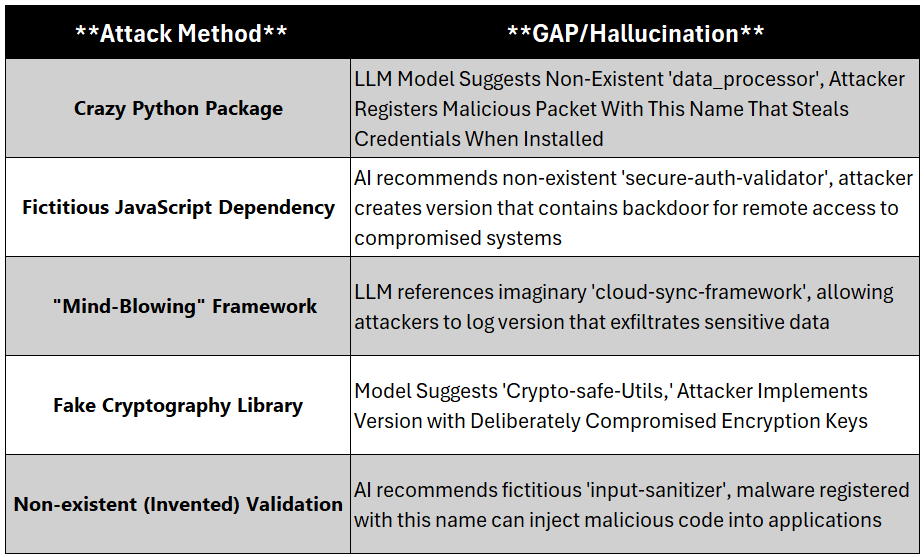 This type of attack is particularly dangerous because, unlike traditional typosquatting, it doesn't rely on human error but exploits the trust placed in AI-generated code, turning hallucinations into attack vectors for the software supply chain.
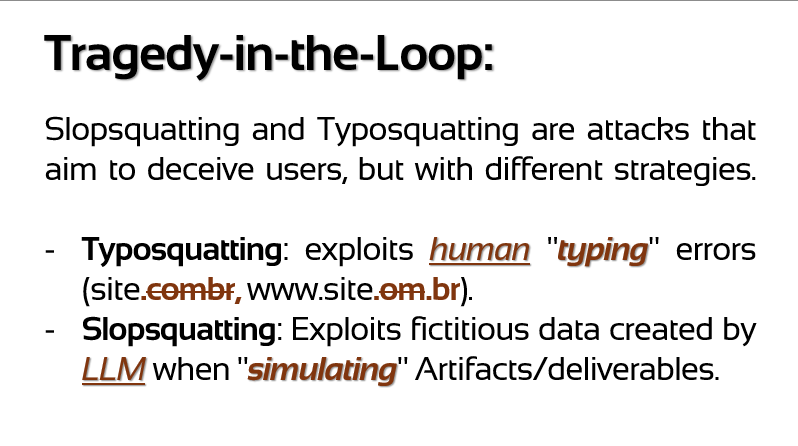 AI-era phenomenon: Slopsquatting for AI Vs. Typosquatting for Humans
Slopsquatting, however, is an AI-era phenomenon: it registers packages "hallucinated" by LLMs during code generation, attacking developers who implement fictitious dependencies without verification.
🏴☠️ - Typosquatting = human typing error, names almost identical to originals, classic attack on domains and packages. (my Bad...!)
🏴☠️ - Slopsquatting = fictitious names generated by AI, dependencies that never existed, modern and automated attack on the software supply chain. (WHAT`s Happ..!??)
Protection in CI/CD Pipelines
CI/CD (Continuous Integration/Continuous Delivery) practices need to be adapted to face the new challenges posed by Slopsquatting. To protect the software supply chain against this type of attack, it is recommended to implement specific security measures:
Implement the principle of least privilege in CI/CD pipelines, ensuring that users and systems have only the necessary permissions to perform specific tasks.
Conduct frequent audits of all software and components used, verifying the origin and integrity of packages.
Rigorously verify the existence and legitimacy of packages recommended by AI tools before including them as dependencies.
Use advanced technologies like AI tools to analyze traffic patterns and detect suspicious activities in the supply chain.
Adopt DevSecOps practices, shifting security tasks to earlier stages in the development cycle ("shift left").
Configure continuous monitoring with SIEM tools to detect anomalous behavior and respond quickly to security incidents.
Implement identity-based microsegmentation for cloud workloads, limiting the impact of lateral movement in case of compromise.
Companies and organizations are responding to this emerging threat by integrating automated security checks into their pipelines, requiring multi-factor authentication for access to high-value assets, and conducting frequent cybersecurity awareness training.
[]`s
Fernando Brito
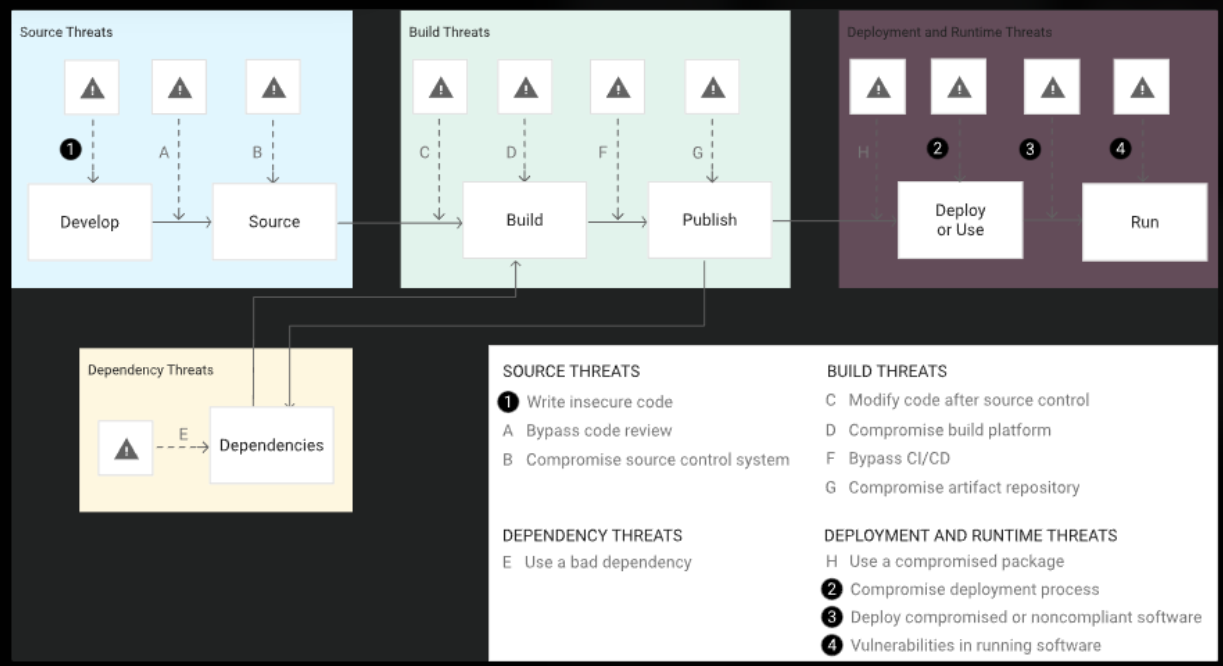
My Sources:
https://www.aibase.com/news/www.aibase.com/pt/news/17562
https://www.datacamp.com/pt/tutorial/gpt-4o-langgraph-tnt-llm
https://www.fortinet.com/br/resources/cyberglossary/supply-chain-attacks
https://www.zscaler.com/br/resources/security-terms-glossary/what-is-a-supply-chain-attack
https://www.keepersecurity.com/pt_BR/threats/supply-chain-attack.html
https://www.fm2s.com.br/blog/ataques-a-cadeia-de-suprimentos
https://www.coopersystem.com.br/cybersquatting-e-typosquatting-qual-e-a-diferenca-entre-eles/
https://www.kaspersky.com.br/resource-center/definitions/what-is-typosquatting
https://powerdmarc.com/pt/what-is-typosquatting/
https://br.clear.sale/blog/cybersquatting
https://www.metacompliance.com/pt/blog/security-awareness-training/typosquatting/
https://www.grafiati.com/en/literature-selections/white-street-house-new-york-n-y/journal/
https://blog.bughunt.com.br/defesa-contra-supply-chain-attacks/
https://vantico.com.br/o-que-e-supply-chain-attack-e-como-se-proteger/
https://blog-pt.lac.tdsynnex.com/3-estrategias-para-fortalecer-a-seguranca-da-supply-chain
https://3structure.com.br/como-manter-a-seguranca-da-cadeia-de-suprimentos-de-software/
https://www.cisoadvisor.com.br/pacotes-de-ia-alucinados-podem-enganar-desenvolvedores/